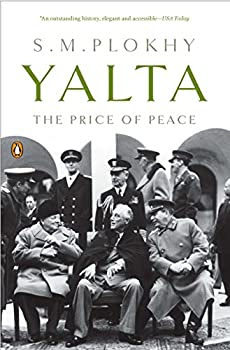
By Serhii Plokhy
Published by Penguin Books
January 2011
480 pages
ISBN: 9780143118923
Summary by Laurisa Hrycyna
In
February 1945, Winston Churchill, Franklin D. Roosevelt and Joseph Stalin met
at Yalta, a resort town on the Black Sea. Over the eight days of the
conference, they partitioned Germany, decided the fate of people living in Eastern
Europe, and laid the foundation for a new international organization to settle
disputes in the future. Despite the enormous significance of the outcome of
these negotiations, there was no official record of the Yalta conference.
With
the collapse of the Soviet Union in 1991, the Soviet archives were opened in
what is referred to as the “archival revolution”. Plokhy reassessed the Yalta
conference in light of these documents, and provides a new perspective on the
Yalta conference.
The
book is factually detailed providing many historical references yet is
surprisingly readable. The book will take some time to read, but is definitely
worthwhile.
The
book begins by describing the journeys made by the three leaders to Yalta.
FDR
set sail on the USS Quincy to Malta with his daughter and select advisors. Churchill’s
party consisted of three planes but only two reached their destination in the
predawn mist. Stalin arrived overland with his contingent of NKVD officers and
Soviet troops.
Each
of the leaders came with their own specific perspectives and objectives.
Stalin
was the most informed and viewed American Imperialism as the enemy. FDR’s
health was seriously declining and was focused on attaining a permanent peace. Churchill’s
goal was to maintain Britain’s interests in Italy, Yugoslavia and Greece which
had communist parties in power. Churchill, Britain’s great orator was often
dismissed by Stalin.
International borders were
redrawn and millions of people were forcibly resettled without consulting the
governments and nations involved. Spheres of influence were created and
Stalin’s rule over Eastern Europe was never overtly challenged.
You will be surprised and
shocked by the parallel of events with russia’s current invasion of Ukraine. russia
the liberator versus the invader; Stalin’s and Putin’s willingness to incur
huge military losses to obtain personal goals of invasion and imperialism.
The Yalta Conference was key
to the official creation of the United Nations – within months of the
conference – as well as the Soviet Union (and subsequently russia) and China
each having veto powers in the UN Security Council. Yalta shows that the
unity of democratic countries is essential to achieve democratic rights and
freedoms. russia’s invasion of Ukraine is showing that this cannot be
forgotten.